Skip to content

Grayson County, Texas

Vinyl Fence Installation in Sherman, Texas

PVC privacy and picket fencing for Grayson County — no staining, no rot, no warping, and a much higher bar for getting the posts right because a vinyl fence cannot be quietly repaired one board at a time.

Homeowners who want a clean white or tan privacy fence, will not stain anything ever again, and are willing to pay more up front to stop maintaining a fence.

Why this works in Grayson County

Vinyl is the one fence type where North Texas heat and North Texas clay pull in opposite directions. The heat is survivable — modern PVC has UV inhibitors and holds up well here. The clay is the problem, because vinyl panels are rigid and span between posts as a single unit. A wood fence absorbs a bit of post movement by racking slightly. A vinyl fence does not: it either stays true or it starts popping panels out of the post channels.

Why homeowners choose it

  • Nothing to stain, seal or refinish — the maintenance is washing it occasionally
  • Does not rot, does not host termites, and will not warp or twist in summer heat
  • Colour goes through the material, so scratches do not expose a different colour underneath
  • Consistent, uniform appearance that many HOA boards prefer and some specifically require
  • Longest useful life of the common privacy options when the posts underneath are set properly

How it fails here — and why

  • Panels working out of the post channels when posts shift, because rigid panels cannot rack to absorb movement
  • Brittleness and cracking on impact in cold snaps, which North Texas gets briefly but genuinely
  • Chalking and dulling on cheap thin-wall extrusions after several summers of direct UV
  • Sagging gates, since a vinyl gate frame needs internal aluminium reinforcement and cheaper ones do not have it
  • Wind damage on tall solid runs, because a vinyl privacy fence is as much of a sail as a wood one but lighter
  • Staining from sprinkler overspray on iron-rich water, which shows far more on white than on wood

Your options

  • Solid privacy panels in white or tan, the most common residential choice and the least forgiving of post movement
  • Semi-privacy or lattice-top panels, which cut wind load while still screening most of the view
  • Vinyl picket in white, which suits front yards where covenants require an open low fence
  • Heavier-wall extrusions with aluminium-reinforced rails and gate frames, which is where the real quality difference sits

How the job runs

  1. 1Walk the line and confirm the boundary, then confirm HOA colour and style rules, which are stricter for vinyl than for wood
  2. 2Confirm city height and setback limits for your address before ordering panels, since vinyl is cut to a plan not fitted on the fly
  3. 3Call 811 for utility locates before digging
  4. 4Set posts to a spacing dictated by the panel width, which leaves no room to adjust later
  5. 5Set posts deep and plumb, with belled footings, because a rigid panel system has no tolerance for later movement
  6. 6Fit panels, then hang reinforced gates and adjust hardware once the concrete has fully cured

What it costs

Vinyl costs noticeably more per linear foot than wood up front and roughly nothing to maintain afterwards, so the comparison only makes sense over the years you expect to own the house. The spread between products is wide and it is mostly wall thickness and whether rails and gate frames are aluminium-reinforced — the cheap extrusions are what give vinyl its reputation for chalking and cracking. Slope also costs more here than with wood, because panels must be stepped or racked rather than simply cut to follow the ground.

Vinyl is the fence you buy when you have decided you are finished maintaining a fence. That is a legitimate thing to want, and for a lot of Grayson County homeowners it is the right call.

It is also the fence type where the quality of the installation matters most, for a reason that is not obvious until it goes wrong.

Rigid panels and moving ground

A wood fence is a collection of individually fastened boards. When a post shifts — and on Blackland clay every post shifts — the fence racks slightly. Boards move a fraction relative to each other, nothing breaks, and mostly you do not notice.

A vinyl fence does not work that way. The panels are rigid units that slot into channels routed into the posts. There is no give. If two posts move relative to one another, the panel between them has nowhere to put that movement, and it starts working its way out of the channel.

This is why vinyl demands better post work than wood on this soil, not less. Deeper setting, belled footings, and posts that are genuinely plumb and genuinely in line. Get it right and vinyl outlasts everything else here. Get it wrong and it fails in a way that cannot be quietly patched.

What actually separates good vinyl from bad

Almost the entire quality difference is in things you would have to pick the product up to notice:

  • Wall thickness. Thin-wall extrusion is what gave vinyl its reputation for chalking, dulling and cracking. Heavier wall costs more and behaves completely differently after five summers.
  • Aluminium reinforcement in rails and, critically, in gate frames. An unreinforced vinyl gate sags, and once it sags the latch stops meeting the catch.
  • Colour through the material rather than a surface coating, so a scrape does not reveal a different colour underneath.

Heat is a fair question and the honest answer is that modern PVC handles North Texas summers well — UV inhibitors are the whole point. Cold is the sharper edge: PVC stiffens in a freeze, and damage during a cold snap usually comes from something hitting it rather than the temperature itself.

Slope costs more than you would expect

On a level lot vinyl is straightforward. On a slope it is not, and Grayson County has plenty of gently rolling ground.

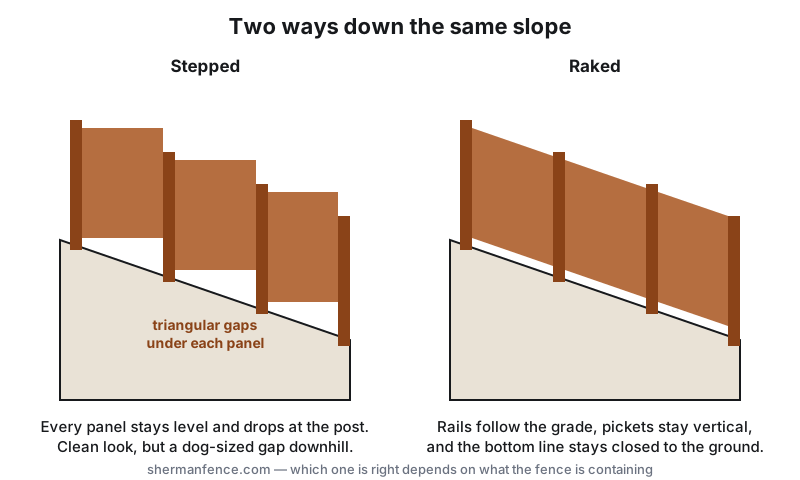
You have two options and they look quite different. Stepping keeps each panel level and drops it at each post, which leaves triangular gaps beneath the panels. Racking flexes the panel into a parallelogram to follow the grade, which needs a system built for it and has a limit on how steep it will go. Wood just gets cut to the ground. Decide this before ordering, because vinyl is manufactured to a plan rather than fitted on site.
HOA boards tend to like it

Vinyl’s uniformity is exactly what a lot of subdivision boards want, and in some newer Grayson County developments a specific vinyl style and colour is what the covenants call for. Because vinyl is ordered rather than built on site, getting the approval sorted before the order goes in matters more than it does with wood.

Vinyl Fence by city

Permit rules, soil and subdivision covenants all change across Grayson County. These pages cover what is specific to each place.

Common questions

Does vinyl fencing hold up in Texas heat?

Yes, better than its reputation suggests. Modern PVC fencing is made with UV inhibitors specifically because sunlight is what degrades it, and it handles North Texas summers without warping the way wood does. What does not hold up is thin-wall budget extrusion, which chalks and dulls after a few seasons. The heat question is really a product quality question. The harder problem here is the clay, not the sun.

Why does vinyl need better post work than wood?

Because a vinyl fence cannot flex. Wood pickets are individually attached and a wood fence racks slightly as posts move, absorbing a bit of soil movement without anything visibly failing. Vinyl panels are rigid units that sit in channels routed into the posts. If posts move relative to each other, the panel has nowhere to go and works its way out of the channel. On Grayson County clay that makes post depth and footing shape more important, not less.

Can vinyl fence follow a slope?

It can, in two ways, and they look different. Stepping means each panel stays level and drops at each post, leaving triangular gaps under the panels on a slope. Racking means the panel parallelogram flexes to follow the grade, which needs a system designed for it and has limits on how steep it can go. Wood simply follows the ground. On a sloped Grayson County lot this is worth deciding early, because it changes both the look and the price.

Will it crack in a cold snap?

PVC gets more brittle as it gets colder, and North Texas does get short hard freezes. In practice, cracking comes from impact during a freeze — a mower, a ladder, a branch — rather than from the cold alone. Better extrusions with thicker walls tolerate it considerably better than budget panels. It is a real consideration, not a reason to rule vinyl out.

Can a damaged vinyl panel be replaced?

Yes, but not the way wood can. With wood you pull two boards and put two boards back, and it costs almost nothing. With vinyl you replace a whole panel, and you need one that matches — which becomes the real problem years later if the product line has changed colour slightly or been discontinued. It is worth keeping a spare panel from the original run in the garage.

Find out what your fence will cost

Send us the property and the fence you have in mind. We measure, walk the line with you, and put the number in writing before anything is ordered.

Monday–Friday, 8am–5pm · Quote requests come in any time.

Get a quote for a vinyl fence

Tell us about the property and the fence you have in mind. The more detail you give, the closer the first number will be.

We use your details to price and schedule your fence, and for nothing else.

Note for the site owner: PUBLIC_WEB3FORMS_KEY is not set, so this form has no destination yet. Add it to .env — see .env.example.

Get a Free Quote