Ornamental iron is what you install when a fence has to do a job without dominating the property. Around a pool it is often the practical answer to a barrier requirement. Across a front yard it reads as architecture. On acreage backing onto open ground it encloses without taking away the reason someone bought the lot.
Wind stops being a factor
Almost everything else on this site comes back to wind and clay. Ornamental iron removes half that equation. A fence made of vertical pickets with air between them is effectively transparent to wind — there is no sail area to speak of, so gusts that put real load into a solid cedar fence pass through this one.
The clay half still applies. Posts are still set in ground that swells and shrinks twice a year, and gate posts still carry constant leverage from a heavy steel gate. Footings get sized for soil movement and for that leverage, not for the weight of a panel that a couple of people can lift.
Corrosion has exactly one cause
Powder coating is the entire corrosion protection on a steel fence. Where the coating is intact, the fence lasts a very long time. Where it is broken, rust starts at that point and spreads underneath the coating from there.
The breaks are predictable:
- Cut ends made on site while fitting to grade, then never re-coated. This is the most common one and the most avoidable.
- Mower and string-trimmer chips at the base of pickets.
- Standing damp where a picket meets soil, made considerably worse by sprinkler overspray hitting one run of fence several times a week.
Aluminum fencing — when it beats steel
Aluminum fencing sidesteps corrosion entirely, because aluminum does not rust. That is its whole argument, and around Sherman it is a genuinely strong one in two places. Immediately around a pool — chlorinated splash plus constant irrigation is exactly the environment that finds every break in a steel fence’s coating — an aluminum fence is usually the right specification. And anywhere sprinklers hit the fence line several times a week, which describes a lot of front-yard ornamental runs in this county’s newer subdivisions.
The trade-offs are honest ones. Aluminum costs more per foot than comparable steel, and it is lighter and less rigid — which matters less on a fence panel than people assume, but matters on gates, where steel’s stiffness earns its keep. On a long, dry perimeter run away from irrigation, powder-coated steel remains sound economics. We install both, and the choice is a placement question rather than a brand one: aluminum where water lives, steel where strength is the point.
Pool barriers start with your city’s code
If the fence is a pool barrier, the requirements come first and the design follows. Barrier rules govern height, maximum gap between pickets, clearance at the bottom, and gate behavior — self-closing, self-latching, with the latch positioned out of a child’s reach and the gate swinging away from the pool.
Which version of those rules applies depends on the code your city has adopted, and that is not uniform across Grayson County. It is worth establishing before anything is designed or priced, because it constrains picket spacing and gate hardware directly.
Following the ground
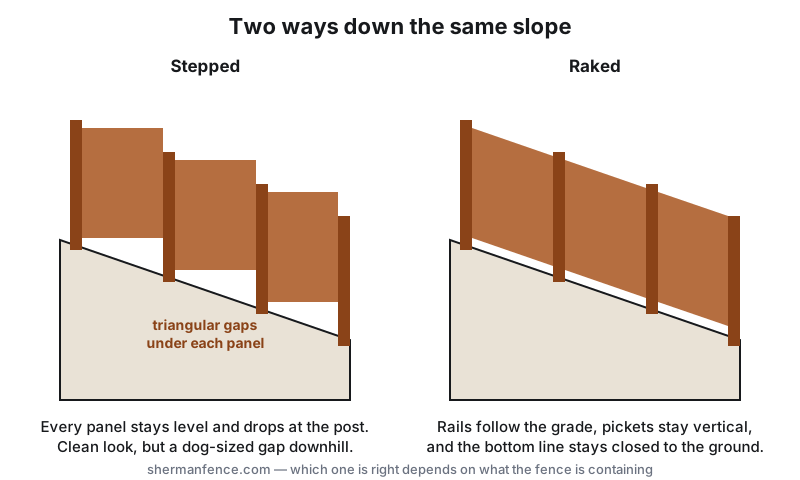
Ornamental iron handles slope better than vinyl. Stepped panels stay level and drop at each post, which suits ground that changes in stages. Raked panels keep the pickets vertical while the rails follow the grade, which looks far better on a consistent slope but has to be ordered that way rather than adjusted on site.
On the gently rolling ground common through this county, that is a decision worth making at design rather than discovering on installation day.