On a 200-foot back yard, the material choice is most of the invoice. Cedar versus vinyl is the decision.
On a half-mile perimeter, material is close to a commodity and the cost — along with whether the fence is still tight in fifteen years — lives almost entirely in the corners, the braces and the gates. That inversion catches people out, because it means the cheapest-looking quote per foot is frequently the one that fails first.
The line is only as good as its corners
A wire fence is a tensioned system. Every foot of wire pulls toward the ends, and all of that load is resisted at corners, ends and gate openings. The line posts in between are mostly just holding the wire at the right height — they carry very little.
A proper corner is a braced assembly: two posts with a horizontal brace between them and a diagonal tension wire, set deeper and heavier than anything else on the property. Build those correctly and the line stays tight for decades. Build them like line posts and the fence goes slack within a season, no matter how good everything else is.
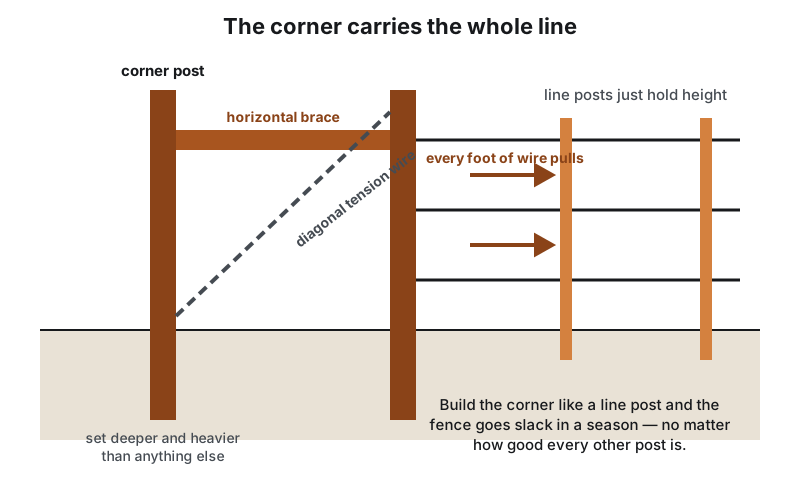
On the Blackland clay through the south of the county, this matters even more than usual, because the soil is working on those posts twice a year while the wire pulls on them continuously.
The animal writes the specification
Budget picks between the options that work. It does not get to pick an option that does not.
Cattle. Barbed wire on T-posts with braced wooden or pipe corners. The long-standing answer, genuinely appropriate, and the lowest cost per foot over long runs.
Horses. Not barbed wire. Horses injure themselves on it badly and repeatedly — this is the clearest specification rule in the whole trade and it is worth being blunt about, because barbed wire is cheaper and the temptation is real. The options are no-climb woven wire mesh with openings too small for a hoof to pass through, pipe fencing where the budget allows, or cable where visibility and some give on impact are both wanted. Whatever the choice, something visible along the top matters, because a horse needs to see a fence to respect it.
Goats. Goats defeat most things and will work the bottom of the fence specifically. No-climb mesh with small openings, and real attention to how the bottom is secured.
Dogs. Usually not a perimeter problem. Making a half-mile boundary dog-proof is rarely worth the cost when a yard fence near the house does the job.
Two fences, not one
Most rural properties around here end up with two entirely separate fences, and that is the right layout rather than a compromise:
- A working perimeter around the acreage — wire or pipe, built for containment and boundary marking over long runs.
- A yard fence near the house — cedar, ornamental iron, or pipe and cable — enclosing the lived-in area, keeping dogs in, enclosing a pool.
They do different jobs, they are priced differently, and they should be specified separately. A quote that treats the whole property as one fence is not thinking about it properly.
The ground changes west of Sherman
This is where Grayson County gets genuinely unusual, and it matters most for acreage because the runs are long.
The south of the county is Blackland Prairie: deep, heavy, high-smectite clay that swells and shrinks seasonally. Push north and west — Denison, Pottsboro, Whitesboro and out toward the county line — and you move onto the Woodbine sands, where the uplands are sandy loams and loamy sands over a clayey subsoil. It is worth being clear about the direction, because this is usually described as an east-to-west split and it is not one.
For a tensioned wire fence, the consequences change:
- On clay: seasonal heave is the enemy. Corners and braces need setting below the active layer, with belled footings so the soil cannot lift them.
- On sand: the ground grips the post far less, so holding power has to come from the size and depth of the concrete footing. But the sand is usually a cap rather than the whole profile, and the clay under it still moves — so the footing has to be carried past that layer as well, not just made wider.
A brace assembly built to a clay specification on sandy ground, or the reverse, is under-built for the conditions it is actually in. Whitesboro sits in the middle of North Texas horse country for good reasons, and it is also the part of the county where this distinction bites hardest — our ranch fencing in Whitesboro page covers the equestrian side, Pottsboro adds the federal shoreline question, and Gunter draws a hard one-acre line in its own ordinance.
Wind, and why open fencing wins on acreage
There is almost nothing upwind on open ground west and north of Sherman. Wire and pipe fencing carry essentially no wind load, which is one of the reasons they suit long perimeters — a solid panel out there would be a continuous sail and every gust would be transferred into posts standing in soil that is already moving.
If you want a solid privacy fence on acreage, put it near the house where there is some shelter and build it properly, rather than running it along an exposed boundary.
Entrances are their own project
The pipe entrance is the one part of a ranch fence that anyone looks at closely, and it sets the character of the property from the road. Two practical points:
- Ground welds need their coating kept intact. That is where rust starts.
- A wide gate applies serious leverage to the posts either side. Those get set for the leverage, not for the weight of the gate.
Boundaries and shared fences — read this before building
Two cautions, stated plainly.
The old fence is often not the boundary. On acreage, fence lines get built for convenience — around a rock outcrop, along a tree line, where the tractor could reach — and then inherited by assumption for fifty years. If there is any doubt, a survey before building costs far less than a fence in the wrong place and the dispute that follows.
Shared fence obligations in Texas are genuinely complicated. They depend on local stock law as well as state statute, and partition fence obligations between adjoining owners are addressed in the Agriculture Code. Whether any of that applies to your boundary, and whether a neighbor owes anything toward a shared fence, is a legal question and not a fencing one. We will build to whatever line you and your neighbor establish. For settling the line itself, use a surveyor; where money between neighbors is involved, talk to an attorney.