If you search this question you will get an answer built around the frost line: set your posts below the depth at which the ground freezes. It is good advice in Ohio. It is close to meaningless in Grayson County, where frost depth is a matter of inches and has essentially nothing to do with why fences here lean.
Here is what actually governs.
The real mechanism: clay that moves
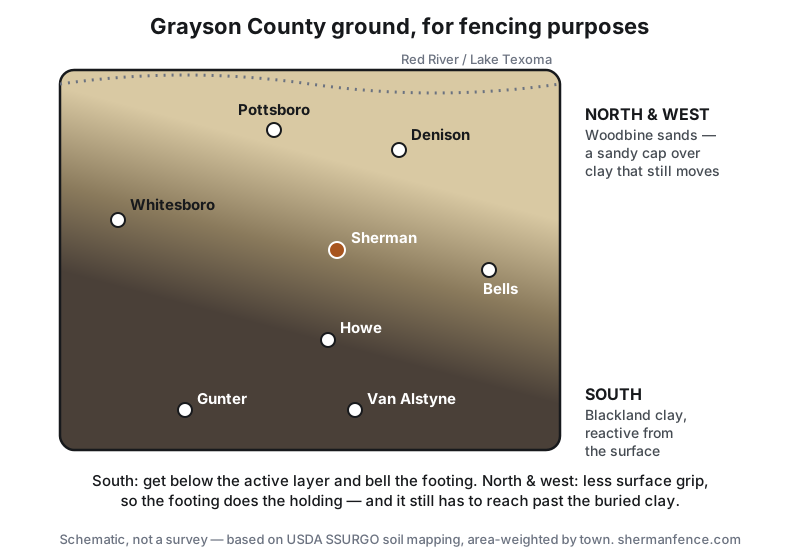
The southern part of this county sits on Blackland Prairie soil. It is deep, dark, extremely fertile, and it carries a very high proportion of smectite — a clay mineral that takes on water into its own crystal structure. Blackland clay content can exceed 60%, which makes it among the most reactive soil in Texas and is the direct reason North Texas has a foundation repair industry at all.
What that means for a fence post:
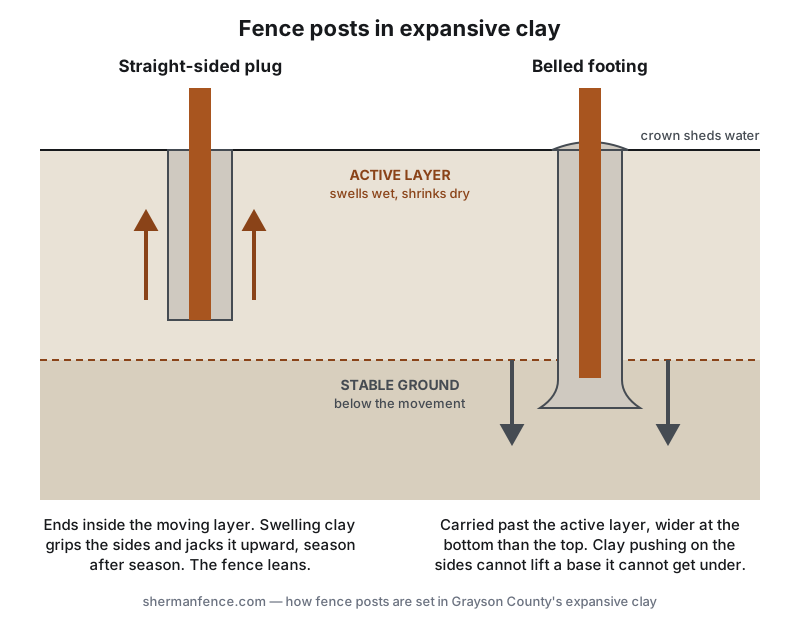
- Wet spring. The clay absorbs water and swells. It presses inward on the post and upward on the footing.
- August drought. It shrinks, cracks open, and pulls away.
- Repeat. Twice a year, every year.
A post set only into that active layer is being gripped and worked on continuously. It does not snap. It migrates. The fence looks fine for two years, slightly off in year three, and visibly out of plumb by year five — and by then the pickets and rails are usually still perfectly sound, which is what makes it so frustrating.
So how deep?
The honest answer is that it depends on your lot, which is why we look at it rather than quote a number down the phone. But the principles are not complicated:
Get below the active layer. The soil that moves is the top portion of the profile. A post that terminates inside it has no anchor in stable ground. General guidance for Texas clay puts residential fence posts in the region of three to four feet, deeper than the “one third of the above-ground height” rule of thumb that gets repeated everywhere, and taller fences need more rather than less.
Post work is also where the real money in a quote hides — it is the largest cost driver in what a fence costs in this county, and the first thing a suspiciously cheap bid cuts.
Bell the bottom of the hole. This is the part most often skipped and it matters enormously. A straight-sided concrete plug is a cylinder that swelling clay can push upward. Widen the base of the hole so the footing is broader at the bottom than the top and it becomes an anchor — clay pressing up against a wider base has nothing to lift.
Size the hole properly. A rough guide is roughly three times the post diameter. Too narrow and there is not enough concrete to resist lateral load; the concrete column itself becomes the weak point.
Crown the top. Finish the concrete so it sheds water away from the post rather than forming a bowl that holds it against the wood. This is the difference between a wood post that rots at the ground line in eight years and one that does not.
Wind is the other half
The second real driver, and the one that is very location-specific inside this county. A solid privacy fence is a continuous sail. Every gust puts load into the posts and then into the soil holding them, and the taller the fence the worse the leverage.
Where this bites hardest is the new subdivisions — Van Alstyne especially, where phases are going up on open former pasture with no mature trees and no neighboring houses yet. A fence there stands in genuinely open ground, and it may stay that way for years before the surrounding phases fill in. It has to be built for the exposure it has now.
Howe has a version of the same problem for a different reason: the town sits on a rise, historically called Summit at around 810 feet and reckoned the high point between the Red River and the Gulf, with open farmland around it.
Chain link, ornamental iron and wire fencing largely sidestep this, because wind passes straight through them. That is a genuine engineering argument for an open fence on an exposed lot, not just an aesthetic one.
The north and west of the county are a different problem
This is the part that national guidance cannot possibly get right, and it matters if you are anywhere toward Denison, Pottsboro or Whitesboro.
The deep Blackland clay is concentrated in the south of Grayson County. Push north and west and you move onto the Woodbine sands, where the surface is light-colored sandy loam and loamy sand over a clayey subsoil — not Blackland clay at all. Note the direction: this is not an east-to-west split, which is how it is usually described. Denison, in the county’s north-east, is one of the sandiest places in it.
The consequences change:
| Blackland clay (south) | Woodbine sands (north and west) | |
|---|---|---|
| Seasonal heave | Severe from the surface down — the main enemy | Usually still there, but lower down |
| Grip on the post | Strong, which is the problem | Weak at the surface, which is the problem |
| What holds the post | Depth below the active layer, belled footing | Footing size and depth, carried past the sand into whatever is under it |
There is one thing to be careful about on the sandy side, because it is where the usual advice goes wrong. The sand is generally a cap, not the whole profile. Only a small share of this ground stays unreactive all the way down; under most of it the clay is still there and still moves, just starting a few inches lower — we walk through what that means lot by lot on our Pottsboro and Whitesboro pages. So you are buying holding power and still setting past a moving layer. The footing has to be big enough, because the surrounding surface is not clamping down the way clay does — and it has to be deep enough to get past the part that does. That matters most on long wire runs under constant tension, where corner and brace assemblies carry the load of the entire line.
Two properties fifteen miles apart in the same county genuinely need different post work. That is unusual, and it is worth knowing about before someone quotes you a single depth for “North Texas”.
Before you dig anything
Call 811. It is free, it is required before digging anywhere in Texas, and it takes a couple of days. Hitting a gas line or a fiber run while putting in a fence post is an expensive and occasionally dangerous way to learn this.
What to ask a contractor
One question sorts most of it: how deep are the posts going, and why that depth?
If the answer mentions a frost line, the number came from somewhere colder. If the answer is a single figure applied to every job regardless of where the property is in this county, it is not accounting for the soil boundary that runs through here. And if nobody mentions belling the footing on clay ground, ask about it.